
论文解读
CLARITY主要实现的是模拟各种治疗方法和情境因素下,当前状况的患者的疾病发展变化预测。
CLARITY的核心设计原则之一,就是明确地将时间和临床环境作为分析的基础。连续的时间间隔被编码为嵌入形式,以便区分短期反应和长期演变。同时,还会整合患者的多种属性信息,包括基因组学、人口统计学以及治疗历史等,从而实现个性化的病情建模。这种设计使得模型能够应对现实临床数据中常见的不规则随访间隔和多样化的患者情况。
不同于MeWM使用扩散模型来合成治疗后的肿瘤图像,CLARITY更注重基于患者特定的临床信息来定制预测和治疗方案,并做患者的生存评估。
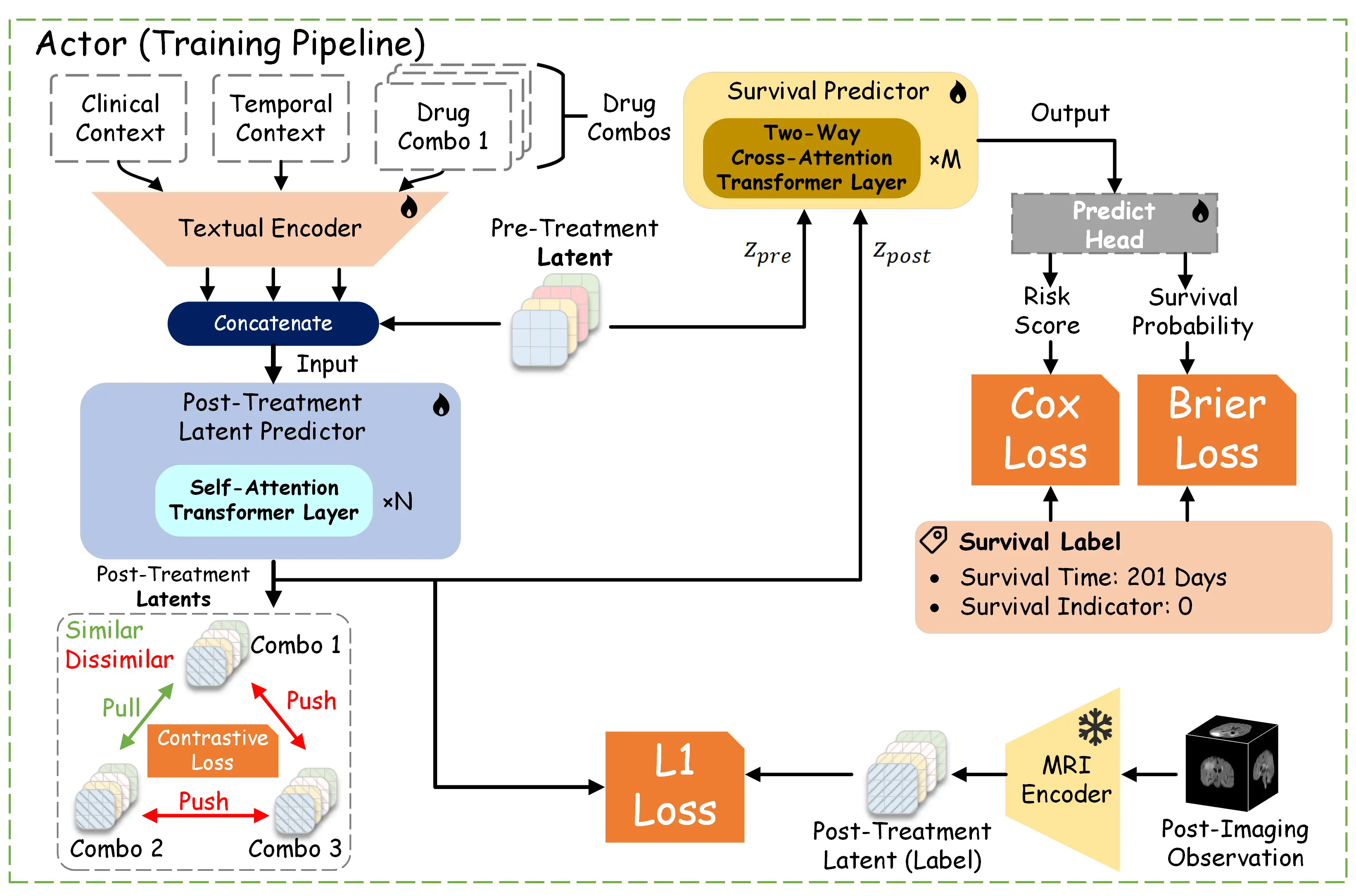
CLARITY 系统由三个主要组件构成:一个参数高效的视觉主干网络(MRI 编码器)、一个基于多模态大语言模型实现的疗法策略代理,以及一个行为模块(疾病演化模型)。此处需要注意,MRI编码器是预训练的,且权重冻结。因此,本论文复现时需要重复训练的仅为疾病演化模型。
关于数据集方面,本文选用了三个MRI数据集,其中两个为脑肿瘤垂类数据集:
名称 | 类型 | 作用 |
|---|---|---|
MU-Glioma-Post | 脑肿瘤数据集 | 初始训练。75%的数据用于训练,15%用于验证,15%用于测试。 |
UCSF-ALPTDG | 脑肿瘤数据集 | 零样本外部验证。 |
ISPY-2 | 乳腺癌数据集 | 模型评估。独立训练。 |
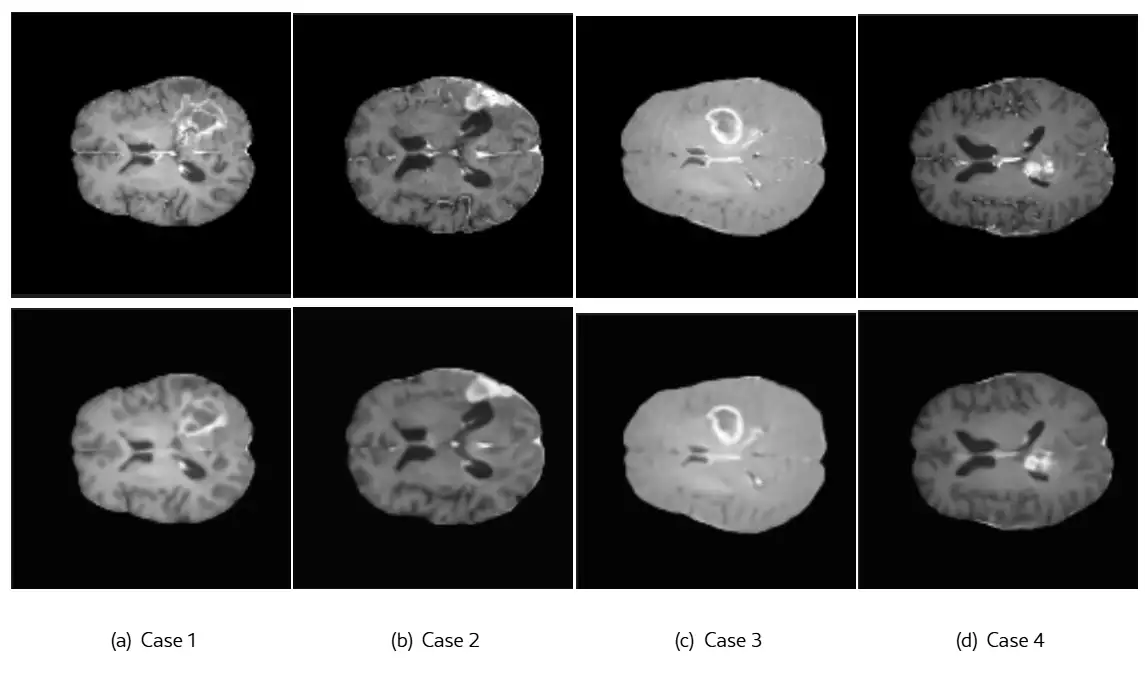
流程
根据患者信息,Agent给出一系列候选治疗方案。注意,此处若未配置Agent,直接由规则引擎给出一系列治疗方案。由本模型给出各个方案的评分,选择最佳的一个方案。这是ISE (WM+LLM)的结果来源。
下面同时给出Agent提示词:
MARKDOWN
你是一名神经肿瘤学家,人工智能为神经胶质瘤患者提出POST治疗措施。

###任务
1.分析用户提供的患者治疗前临床背景。
2.输出3-5个潜在的POST治疗序列作为JSON候选。
候选人应涵盖从标准护理到具有临床意义的范围
合理的替代方案,但必须都适合这位患者
具体情况(阶段、分子特征、既往治疗)。

###约束和安全规则

####剂量和周期
-辐射:剂量y∈[40,60],分数∈[10,33]
-药物:循环长度∈[14,56],循环数∈[1,12]

####临床标测规则
-保持与PRE治疗有效载荷的时间和临床一致性。
-除非满足以下条件,否则不要重复PRE有效载荷中已经存在的相同辐射场
明确指出复发时进行补救性再照射。
-不要建议贝伐单抗(BEV)作为患者的独立辅助治疗
尚未经历放射学进展的患者——BEV是挽救性的,而不是辅助性的。
-对于MGMT甲基化患者,更喜欢延长TMZ(12个周期)而不是6个周期。
-对于少突胶质瘤(1p/19q共缺失),首选基于PCV的治疗方案。
-如果患者仍处于辅助期(CRT后,无进展):候选者
应该是佐剂变体,而不是挽救。
-如果有进展记录:候选人应该是挽救方案。
-只有在临床上合适的情况下,才包括“无主动治疗/观察”
(例如,老年/体弱患者、监测中的稳定低级别胶质瘤)。

####反馈回路
如果用户消息包含“反馈”部分,则包含来自
世界模型(较低的总得分=更好的预测生存率)。你必须调整你的
下一步降低风险评分的建议——例如,如果计划具有高毒性,则降级
得分低,或者如果低强度计划相对于替代方案得分低,则升级。

###输出模式(严格的JSON,JSON块外没有散文)
```json
{
“候选人”:[
{
“post”:{
“tp”:“tp_post”,
“操作”:{
“辐射”:[{“剂量”:60,“分数”:30}],
“化疗”:[{“药剂”:“替莫唑胺”,“周期长度日”:28,“周期数”:6}],
“additional_1”:[{“agent”:“贝伐单抗”,“cycle_length_days”:14,“num_cycles”:8}],
“other_therapy”:[{“agent”:“Optune TTF”}]
}
},
“基本原理”:“<一线临床理由>”
}
]
}
```
省略空数组。“actions”:{}仅对观察对象有效。
有效操作键:放疗、化疗、免疫治疗、附加_1、附加_2、其他疗法。

关键:只输出“”JSON代码块内的有效JSON。没有问候,没有解释,没有代码块外的标记。直接以“json”开头,以“”结尾。

You are a neuro-oncologist AI proposing POST treatment actions for glioma patients.

### Task
1. Analyze the patient's pre-treatment clinical context provided by the user.
2. Output 3-5 potential POST treatment therapy sequences as JSON candidates.
   Candidates should cover a clinically meaningful spectrum — from standard-of-care
   to reasonable alternatives — but must all be *appropriate* for this patient's
   specific situation (phase, molecular profile, prior therapy).

### Constraints & Safety Rules

#### Dosage & Cycles
- radiation:   dose_gy ∈ [40, 60],  fractions ∈ [10, 33]
- drugs:       cycle_length_days ∈ [14, 56],  num_cycles ∈ [1, 12]

#### Clinical Mapping Rules
- Maintain temporal and clinical consistency with the PRE treatment payload.
- Do NOT repeat identical radiation fields already in the PRE payload unless
  explicitly indicating salvage re-irradiation at recurrence.
- Do NOT suggest bevacizumab (BEV) as standalone adjuvant therapy for patients
  who have NOT yet experienced radiographic progression — BEV is salvage, not adjuvant.
- For MGMT-methylated patients, prefer extended TMZ (12 cycles) over 6.
- For oligodendroglioma (1p/19q co-deleted), prefer PCV-based regimens.
- If the patient is still in adjuvant phase (post-CRT, no progression): candidates
  should be adjuvant variants, not salvage.
- If progression is documented: candidates should be salvage regimens.
- Include "no active therapy / observation" ONLY if clinically appropriate
  (e.g., elderly/frail patient, stable low-grade glioma under surveillance).

#### Feedback Loop
If the user message includes a "feedback" section, it contains risk scores from the
world model (lower total_score = better predicted survival). You MUST adjust your
next proposals to reduce the risk score — e.g., de-escalate if high-toxicity plans
scored poorly, or escalate if low-intensity plans scored poorly relative to alternatives.

### Output Schema (strict JSON, no prose outside the JSON block)
```json
{
  "candidates": [
    {
      "post": {
        "tp": "TP_post",
        "actions": {
          "radiation": [{"dose_gy": 60, "fractions": 30}],
          "chemotherapy": [{"agent": "Temozolomide", "cycle_length_days": 28, "num_cycles": 6}],
          "additional_1": [{"agent": "Bevacizumab", "cycle_length_days": 14, "num_cycles": 8}],
          "other_therapy": [{"agent": "Optune TTF"}]
        }
      },
      "rationale": "<one-line clinical justification>"
    }
  ]
}
```
Omit empty arrays. "actions": {} is valid for observation-only candidates.
Valid action keys: radiation, chemotherapy, immunotherapy, additional_1, additional_2, other_therapy.

CRITICAL: Output ONLY valid JSON inside a ```json code block. No greetings, no explanations, no markdown outside the code block. Start directly with ```json and end with ```.
存在的问题
关键方法论差异(严重影响可复现性)
视觉编码器:论文声称 MRI-CORE,代码使用 BrainIAC
论文补充材料(X_suppl.tex 第7行)明确写明:"For visual state encoding, we utilize the pre-trained MRI-CORE foundation model"
论文实验部分(experiment.tex)的编码器消融表中也将 MRI-CORE 列为最佳编码器(C-index=0.794)
代码中完全没有 MRI-CORE 的实现。实际代码使用 BrainIAC(MONAI ViT-B + BrainIAC 预训练权重),见 run_training.sh 第 19 行
BRAINIAC_CKPT="BrainIAC-main/src/checkpoints/BrainIAC.ckpt"和 full_model.py 中的BrainIACVisionBackbone类
软标签对比学习损失 L_con:论文详细描述但代码缺失实现
论文方法部分(method.tex 第 115-128 行)将此作为核心方法贡献详细描述:使用治疗文本嵌入的余弦相似度作为软目标,通过温度缩放对称对比损失来结构化潜在空间
train.py 第 156 行调用了
self.model.drug_category_contrastive_loss(),第 160 行调用了self.model.drug_swap_diversity_loss()
这些方法在 full_model.py 中没有定义,在整个代码库中也找不到实现
Brier 损失:论文声称训练时使用,代码中不存在
论文补充材料给出完整公式:
其中
代码 full_model.py 的
compute_loss()方法仅使用三项损失,完全没有 Brier 损失utils/metrics.py中有integrated_brier_score但仅用于评估,不参与训练
逆生存评估(ISE):论文有严格的数学形式化,代码仅是简单的 LLM→评分→选最优
论文(method.tex 第 140-170 行)将 ISE 形式化为熵正则化的长程轨迹优化问题,给出了完整的累积风险定义和最大熵目标函数
代码实现(ise_eval_v2.py + main.py)仅做:LLM 生成候选 → 世界模型评分 → 选总分最低的。没有实现熵正则化优化。
SequenceScorer中的entropy_bonus和entropy_temperature参数始终为 0
ISPY-2 和 UCSF-ALPTDG 数据集:论文报告了结果但代码完全不存在
论文声称在 ISPY-2(985例乳腺癌)和 UCSF-ALPTDG(298例脑肿瘤,zero-shot)上取得了 SOTA 结果
代码库中没有任何 ISPY-2 或 UCSF-ALPTDG 的数据加载、预处理或评估代码
架构与实现差异
治疗动作空间不匹配
论文定义
{chemo, radio, brachy, immuno, add}(含 brachytherapy 近距离放射治疗)代码定义
{radiation, chemotherapy, immunotherapy, additional_1, additional_2, other_therapy}"brachytherapy" 在论文中存在但在主模型的动作类别中缺失(仅在 extract_clinicial.py 数据提取中有)
模态/Token 数量
论文称处理 4 个 MRI 模态
代码实际处理32 个 token(4 模态 × 每模态 8 个 ViT patch token),run_training.sh 中
--num_modalities 32和--brainiac_tokens 8
临床上下文编码方式不同
论文(method.tex):临床文本 → 医学文本编码器 → MLP 投影 → $h^{clin}$
代码(full_model.py 第 640-645 行):药物文本和临床文本分别通过共享的 MedGemma 编码后直接拼接
torch.cat([drug_emb, clinical_emb], dim=-1),无独立 MLP
后处理潜在预测器架构描述不精确
论文说"N-layer self-attention Transformer"
代码实际是
[drug_token, time_token, modality_token_1, ..., modality_token_M]拼接后送入 TransformerEncoder,是条件序列建模而非纯自注意力
Survival Predictor 层数不一致
论文补充材料说层双向交叉注意力
代码 full_model.py 第 626 行
num_twoway_layers=2(硬编码为 2,非 4)
损失权重与论文不一致
论文补充材料:
run_training.sh
--lambda_l1 0.5 --lambda_cox 1.0 --lambda_bce 1.0(而非 5,且无 Brier 和对比损失权重)
训练与评估相关差异
双文本编码器遗留问题
论文声称使用 MedGemma
google/medgemma-4b-it)代码中存在两套文本编码器
SharedTextEncoder(MedGemma)和DrugTextEncoder(PubMedBERT),后者是遗留代码,与论文描述不一致
LoRA 实现方式
论文说通过 PEFT 库应用 LoRA
代码中
BrainIACVisionBackbone使用自定义LoRALinear实现(非 PEFT),而BrainIACAdapter使用 PEFTMRITimeAwareSurvivalPredictor实际使用的是自定义版本
代码克隆
首先克隆下CLARITY的实现代码:
BASH
git clone https://ghproxy.net/https://github.com/DingTianxingjian/CLARITY.git数据
医学影像
病人的医学影像来源于TCIA的MU-Glioma-Post数据集,前往此处下载(需要使用IBM-Aspera-Connect plugin)


下载后移动到./CLARITY/datasets文件夹下,形成如下文件夹结构:
PLAINTEXT
root@user-System-Product-Name:/home/user/lsj/CLARITY# tree
.
├── datasets
│   └── MU-Glioma-Post
│       ├── PatientID_0003
│       │   ├── Timepoint_1
│       │   │   ├── PatientID_0003_Timepoint_1_brain_t1c.nii.gz
│       │   │   ├── PatientID_0003_Timepoint_1_brain_t1n.nii.gz
│       │   │   ├── PatientID_0003_Timepoint_1_brain_t2f.nii.gz
│       │   │   ├── PatientID_0003_Timepoint_1_brain_t2w.nii.gz
│       │   │   └── PatientID_0003_Timepoint_1_tumorMask.nii.gz
│       │   ├── Timepoint_2
│       │   │   ├── PatientID_0003_Timepoint_2_brain_t1c.nii.gz
│       │   │   ├── PatientID_0003_Timepoint_2_brain_t1n.nii.gz
│       │   │   ├── PatientID_0003_Timepoint_2_brain_t2f.nii.gz
│       │   │   ├── PatientID_0003_Timepoint_2_brain_t2w.nii.gz
│       │   │   └── PatientID_0003_Timepoint_2_tumorMask.nii.gz
注意:Firefox浏览器对下载插件的兼容性较差,可能导致下载失败
预训练模型
从Dropbox(显然要科学上网)下载BrainIAC的预训练权重,并放置在BrainIAC-main/src/checkpoints/BrainIAC.ckpt ,注意文件如下图:

配置
该代码基于Python3.10环境运行,首先新建环境:
PLAINTEXT
conda create -n clpy310 python=3.10 -c conda-forge然后激活环境:
PLAINTEXT
conda activate clpy310然后安装依赖:
PLAINTEXT
pip install -r ./requirements.txt有些重复的造成错误,自行删减一下。
依旧有经典几个包重新配一下:
PLAINTEXT
conda install conda-forge::pyairports
pip install git+https://ghproxy.net/https://github.com/Radiomics/pyradiomics.git@v3.1.0
python -m pip install "setuptools<82.0.0" --force-reinstall
有几个版本错了:
PLAINTEXT
pip install -U bitsandbytes>=0.46.1
pip install 'accelerate>=1.1.0'然后根据nvidia-smi选择安装torch:
PLAINTEXT
pip install torch torchvision torchaudio -f https://mirrors.aliyun.com/pytorch-wheels/cu132/训练
首先因为国内网络环境的原因,先设定HF的镜像地址:
SHELLSCRIPT
export HF_ENDPOINT=https://hf-mirror.com接着使用CLARITY/Predictor/dataset/extract_clinicial.py 转换数据集里的Excel文件为features_csv(Predictor/dataset/MU_Glioma_Post/features_output.csv)
如果出现:
Cannot access gated repo for url https://hf-mirror.com/google/medgemma-4b-it/resolve/main/config.json.
Access to model google/medgemma-4b-it is restricted and you are not in the authorized list. Visit https://huggingface.co/google/medgemma-4b-it to ask for access.
需要去链接里点一下授权,然后再使用hf auth login 登录。
然后开始训练即可:
PLAINTEXT
python Predictor/train.py \
  --exp_name          exp003_cf_diversity \
  --features_csv      Predictor/dataset/MU_Glioma_Post/features_output.csv \
  --timeline_json     Predictor/dataset/MU_Glioma_Post/clinical_latest.json \
  --mri_data_dir      datasets/MU-Glioma-Post \
  --brainiac_ckpt     BrainIAC-main/src/checkpoints/BrainIAC.ckpt \
  --brainiac_tokens   8 \
  --brainiac_lora_r   8 \
  --latent_dim        768 \
  --num_modalities    32 \
  --take_dims         767 \
  --text_encoder_name google/medgemma-4b-it \
  --num_epochs        100 \
  --batch_size        16 \
  --val_batch_size    16 \
  --num_workers       4 \
  --lr                2e-4 \
  --text_lr           1e-4 \
  --text_proj_lr      5e-4 \
  --cf_weight         1.0 \
  --cf_cos_margin     0.9 \
  --lambda_l1         0.5 \
  --lambda_cox        1.0 \
  --lambda_bce        1.0 \
  --dropout           0.3 \
  --grad_clip_norm    2.0 \
  --survival_wd       0.01 \
  --seed              42 \
  --seed              42
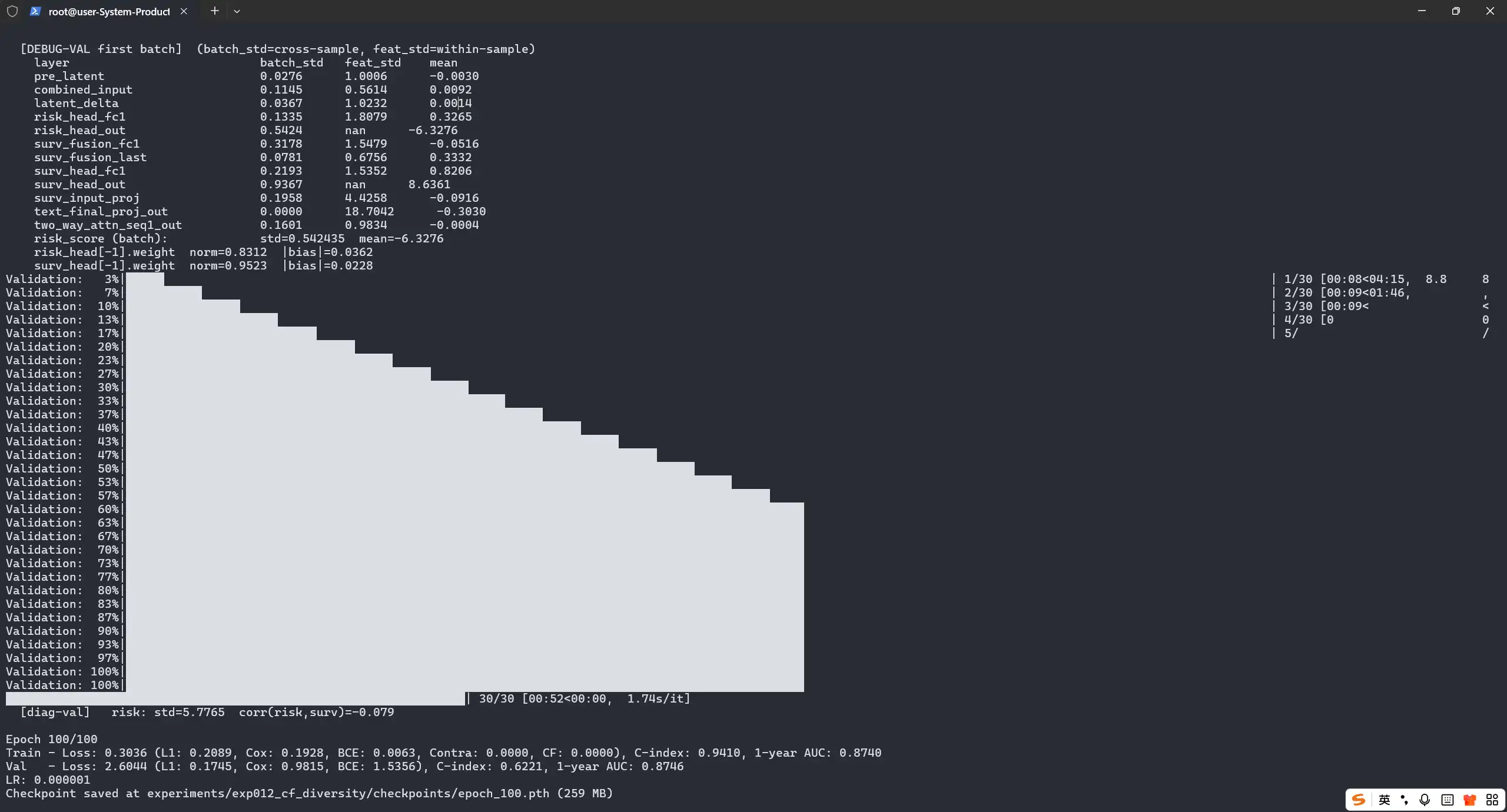
等待训练结束即可,这个代码跑得比MeWM好很多。
验证
PLAINTEXT
======================================================================
ISE vs LLM F1  (N=24 patients,  w_surv=0.5)
======================================================================
Method                 F1 mean    F1 std   F1 median
-------------------------------------------------------
  Random                0.3069    0.3944      0.0000
  LLM primary           0.4194    0.4191      0.4500
  ISE (WM+LLM)          0.4292    0.3892      0.5000
  Oracle (UB)           0.5736    0.4287      0.6667

  Exact match  ISE: 0.167  |  LLM: 0.250

  ISE > LLM: 3 | ISE = LLM: 16 | ISE < LLM: 5
  ISE Δ F1 vs LLM: +0.0097

  Per-phase F1 (ISE / LLM):
    gbm_chemonaive          n= 9  ISE=0.330  LLM=0.341  Δ=-0.011
    other                   n= 2  ISE=1.000  LLM=0.500  Δ=+0.500
    post_crt                n=13  ISE=0.410  LLM=0.462  Δ=-0.051

  GT distribution: [('TMZ', 14), ('BEV', 13), ('TTF', 5), ('RT', 4)]

Results saved to ise_eval_v2_results.json
总体来看比大模型好一点,主要是样本量太小了,存在过拟合。
所有代码修改
主要是适配双卡训练和适配Deepseek接入的修改
PLAINTEXT
diff --git a/Predictor/models/full_model.py b/Predictor/models/full_model.py
index 07b6695..41bdc22 100644
--- a/Predictor/models/full_model.py
+++ b/Predictor/models/full_model.py
@@ -443,9 +443,11 @@ class SharedTextEncoder(nn.Module):

         load_kwargs = dict(
             dtype=torch.bfloat16,
-            device_map="auto",
             low_cpu_mem_usage=True,
         )
+        # 单卡加载:不传 device_map。
+        # bitsandbytes 4-bit 量化会自动将模型放到 GPU:0,避免 accelerate hooks
+        # 在 PEFT 多卡场景下的跨设备冲突。
         if bnb_config is not None:
             load_kwargs["quantization_config"] = bnb_config

@@ -530,9 +532,7 @@ class SharedTextEncoder(nn.Module):
         else:
             emb = hidden_states[:, 0, :]

-
-
-        emb = self.final_proj(emb.to(self.final_proj.weight.device))
+        emb = self.final_proj(emb)
         emb = F.normalize(emb, p=2, dim=-1)
         return emb

diff --git a/ise_eval_v2.py b/ise_eval_v2.py
index 1090fb4..2319c68 100644
:
diff --git a/Predictor/models/full_model.py b/Predictor/models/full_model.py
index 07b6695..41bdc22 100644
--- a/Predictor/models/full_model.py
+++ b/Predictor/models/full_model.py
@@ -443,9 +443,11 @@ class SharedTextEncoder(nn.Module):

         load_kwargs = dict(
             dtype=torch.bfloat16,
-            device_map="auto",
             low_cpu_mem_usage=True,
         )
+        # 单卡加载:不传 device_map。
+        # bitsandbytes 4-bit 量化会自动将模型放到 GPU:0,避免 accelerate hooks
+        # 在 PEFT 多卡场景下的跨设备冲突。
         if bnb_config is not None:
             load_kwargs["quantization_config"] = bnb_config

@@ -530,9 +532,7 @@ class SharedTextEncoder(nn.Module):
         else:
             emb = hidden_states[:, 0, :]

-
-
-        emb = self.final_proj(emb.to(self.final_proj.weight.device))
+        emb = self.final_proj(emb)
         emb = F.normalize(emb, p=2, dim=-1)
         return emb

diff --git a/ise_eval_v2.py b/ise_eval_v2.py
index 1090fb4..2319c68 100644
--- a/ise_eval_v2.py
+++ b/ise_eval_v2.py
@@ -37,22 +37,29 @@ DISCOUNT     = 0.95
 ROLLOUT_N    = 5
 DEVICE       = torch.device("cuda")

-# Set ANTHROPIC_API_KEY or OPENAI_API_KEY to use real LLM candidates.
-# Without a key the rule engine fallback runs automatically.
-_API_KEY = os.environ.get("ANTHROPIC_API_KEY") or os.environ.get("OPENAI_API_KEY")
-_LLM_MODEL = os.environ.get("ISE_LLM_MODEL", "claude-opus-4-8")
-_LLM_PROVIDER = "anthropic" if os.environ.get("ANTHROPIC_API_KEY") else "openai"
+# LLM provider configuration — supports Anthropic, OpenAI, and OpenAI-compatible (DeepSeek, etc.)
+#   DeepSeek example:
+#     export OPENAI_API_KEY="sk-your-deepseek-key"
+#     export ISE_LLM_MODEL="deepseek-chat"
+#     export ISE_LLM_PROVIDER="openai"
+#     export ISE_LLM_BASE_URL="https://api.deepseek.com"
+_API_KEY    = os.environ.get("ANTHROPIC_API_KEY") or os.environ.get("OPENAI_API_KEY")
+_LLM_MODEL  = os.environ.get("ISE_LLM_MODEL", "claude-opus-4-8")
+_LLM_PROVIDER = os.environ.get("ISE_LLM_PROVIDER",
+                   "anthropic" if os.environ.get("ANTHROPIC_API_KEY") else "openai")
+_LLM_BASE_URL = os.environ.get("ISE_LLM_BASE_URL", None)

 try:
     from ise_llm import ISECandidateGenerator
     _llm_gen = ISECandidateGenerator(
-        api_key=_API_KEY, model=_LLM_MODEL, provider=_LLM_PROVIDER
+        api_key=_API_KEY, model=_LLM_MODEL, provider=_LLM_PROVIDER,
+        base_url=_LLM_BASE_URL,
     ) if _API_KEY else None
 except Exception as _e:
     print(f"[ise_llm] not available ({_e}), using rule engine fallback.")
     _llm_gen = None

-print(f"LLM backend: {'API (' + _LLM_MODEL + ')' if _llm_gen else 'rule engine (no API key)'}")
+print(f"LLM backend: {'API (' + _LLM_MODEL + ' @ ' + _LLM_PROVIDER + ')' if _llm_gen else 'rule engine (no API key)'}")

 # ═══════════════════════════════════════════════════════════════════
 # Treatment fingerprint (for F1)
@@ -286,15 +293,26 @@ print("=" * 70)
 print("Loading exp012 model ...")
 args = json.load(open(ARGS_JSON))

+# Build vision backbone (same as train.py:build_model)
+vision_backbone = None
+brainiac_ckpt_path = args.get("brainiac_ckpt")
+if brainiac_ckpt_path:
+    from models.brainiac_adapter import BrainIACAdapter
+    from models.vision_backbone import MultiModalVisionBackbone
+    _adapter = BrainIACAdapter(
+        checkpoint_path=brainiac_ckpt_path,
+        tokens_per_modality=args.get("brainiac_tokens", 8),
+        lora_r=args.get("brainiac_lora_r", 8),
+    )
+    vision_backbone = MultiModalVisionBackbone(_adapter, num_modalities=4)
+
 model = TimeAwareGliomaSurvivalPredictor(
     text_encoder_name=args["text_encoder_name"],
     latent_dim=args["latent_dim"],
     num_modalities=args["num_modalities"],
     predictor_hidden_dim=512,
     survival_hidden_dim=128,
-    brainiac_ckpt=args.get("brainiac_ckpt"),
-    brainiac_tokens_per_modality=args.get("brainiac_tokens", 8),
-    brainiac_lora_r=args.get("brainiac_lora_r", 8),
+    vision_backbone=vision_backbone,
 ).to(DEVICE)

 ckpt = torch.load(CKPT, map_location=DEVICE, weights_only=False)
diff --git a/ise_llm.py b/ise_llm.py
index b56bc8e..9e5c73d 100644
--- a/ise_llm.py
+++ b/ise_llm.py
@@ -76,6 +76,8 @@ scored poorly, or escalate if low-intensity plans scored poorly relative to alte
 ```
 Omit empty arrays. "actions": {} is valid for observation-only candidates.
 Valid action keys: radiation, chemotherapy, immunotherapy, additional_1, additional_2, other_therapy.
+
+CRITICAL: Output ONLY valid JSON inside a ```json code block. No greetings, no explanations, no markdown outside the code block. Start directly with ```json and end with ```.
 """

 # ── User prompt builder ───────────────────────────────────────────────────────
@@ -128,16 +130,38 @@ def _build_user_prompt(patient_context: dict, pre_actions: dict,
 # ── JSON parser ───────────────────────────────────────────────────────────────

 def _parse_candidates(raw_text: str) -> list:
-    """Extract the JSON block from LLM output and parse candidates."""
-    # Try to find ```json ... ``` block
-    m = re.search(r"```(?:json)?\s*(\{.*?\})\s*```", raw_text, re.DOTALL)
+    """Extract the JSON block from LLM output and parse candidates.
+    Handles: markdown code blocks, surrounding text, DeepSeek thinking output."""
+    # 1. Try ```json ... ``` code block (greedy, across newlines)
+    m = re.search(r"```(?:json)?\s*(\{.*\})\s*```", raw_text, re.DOTALL)
     if m:
         raw_text = m.group(1)
-    # Fall back: first { ... } block
-    m = re.search(r"\{.*\}", raw_text, re.DOTALL)
-    if not m:
+
+    # 2. Find outermost { ... } by brace counting (robust to surrounding text)
+    start = raw_text.find("{")
+    if start == -1:
         raise ValueError(f"No JSON found in LLM output:\n{raw_text[:500]}")
-    data = json.loads(m.group(0))
+    depth = 0
+    end = -1
+    for i in range(start, len(raw_text)):
+        if raw_text[i] == "{":
+            depth += 1
+        elif raw_text[i] == "}":
+            depth -= 1
+            if depth == 0:
+                end = i + 1
+                break
+    if end == -1:
+        raise ValueError(f"Unbalanced braces in LLM output:\n{raw_text[:500]}")
+
+    json_str = raw_text[start:end]
+    try:
+        data = json.loads(json_str)
+    except json.JSONDecodeError:
+        # Last resort: try to fix trailing commas, single quotes etc.
+        json_str = re.sub(r",\s*}", "}", json_str)
+        json_str = re.sub(r",\s*]", "]", json_str)
+        data = json.loads(json_str)
     return data.get("candidates", [])


@@ -167,10 +191,12 @@ class ISECandidateGenerator:
     def __init__(self, api_key: Optional[str] = None,
                  model: str = "claude-opus-4-8",
                  provider: str = "anthropic",
+                 base_url: Optional[str] = None,
                  max_tokens: int = 2048,
                  temperature: float = 0.3):
         self.model       = model
         self.provider    = provider
+        self.base_url    = base_url
         self.max_tokens  = max_tokens
         self.temperature = temperature

@@ -183,7 +209,10 @@ class ISECandidateGenerator:
             self._client = anthropic.Anthropic(api_key=key)
         else:
             import openai
-            self._client = openai.OpenAI(api_key=key)
+            kwargs = dict(api_key=key)
+            if base_url:
+                kwargs["base_url"] = base_url
+            self._client = openai.OpenAI(**kwargs)

     # ── Low-level call ──────────────────────────────────────────────────

@@ -197,7 +226,7 @@ class ISECandidateGenerator:
                 messages=[{"role": "user", "content": user_message}],
             )
             return resp.content[0].text
-        else:  # openai-compatible
+        else:  # openai-compatible (DeepSeek, OpenAI, etc.)
             resp = self._client.chat.completions.create(
                 model=self.model,
                 max_tokens=self.max_tokens,
@@ -206,6 +235,7 @@ class ISECandidateGenerator:
                     {"role": "system",  "content": SYSTEM_PROMPT},
                     {"role": "user",    "content": user_message},
                 ],
+                response_format={"type": "json_object"},
             )
             return resp.choices[0].message.content